Writing, promotion, tips, and opinion. Pour a cuppa your favorite poison and join in.

Showing posts with label grammar. Show all posts

Friday, November 18, 2016

Dear “I Hate Grammar!” Writer


Dear “I Hate Grammar!” Writer,

Many writers hate grammar. I used to be one of them. But to write well you have to understand grammar to some extent. In this post, I am providing quick rules, examples, and tips to help you understand some areas of grammar.

Image from Pixabay


1. You and I or You and me?

The quickest way to figure this out is to cut out “You and” from the sentence. Does “I” sound better or does “me?” Whichever one makes more sense is the correct pronoun.

Ex: Where would you like Mary and me to stand?

Sounds good. "Me” is correct.

Now let's look at it this way:

Ex: Where would you like Mary and I to stand?

Sounds bad. “I” is incorrect.

TIP: The POV we are in is always mentioned last. Ex: Mom and I went to the mall.


2. Italic letters or quotations for the names of songs/books/movies/TV shows?

The names of songs and other short works part of a bigger work (chapter titles, names of TV show episodes) are always in quotation marks.

EX: I listened to “Baby One More Time” on repeat.

The names of whole works such as books, movies, and TV shows are italic.

EX: I watched Gone with the Wind last night.


3. Who or whom?

Who – he/she/they

Whom – him/her/them

Ex: The woman who hit my car.

She hit me car. (Who is correct.)

Ex: To whom do I address this letter?

Do I address this letter to him/her/them? (Whom is correct.)


4. When to capitalize titles with names.

Always capitalize titles when they appear with a name.

Ex: President Obama, Queen Elizabeth, Dr. Cristina Yang, Chef Ramsey.

Capitalize titles used as a substitute for a name. When it’s like this, it’s like a nickname.

Ex: I looked at the Chief and knew the criminal got away.
("Chief" is referring to one person and is in place of a name.)

Lowercase the title when the term is used in a general way, not for a specific person.

Ex: The duties of a president are daunting. 


7 Fast Tips:

-       Seasons (summer, autumn, winter, spring) are lowercase.

-       Directions (north, east, south, west) are also lowercase.

-       Use em dashes at the end of dialogue when there’s an abrupt stop, such as when one character cuts off another character’s speech.

-       Use single quotation marks inside double quotations when a character is quoting someone.

-       No question mark for an indirect question.

-       There’s no such word as “alright.” Correct: All right

-       “Already” means it happened in the past. “All ready” means prepared. 


Author of Hurricane Crimes, Seismic Crimes, 30 Seconds Before, and 30 Seconds. Blogger. Reader. Auntie. Vegetarian. Cat Lover.


Friday, March 11, 2016

Sin and Syntax - how to craft wickedly effective prose (cont)

This week I'm sharing some bits with you from one of my favorite writing books: Sin and Syntax by Constance Hale.


Today I'm going to finish up with Hale's chapter on adverbs...


The Bones: "Adverbs are more promiscuous than adjectives" Hale says, and "express either Time (immediately, now, soon), Place (here, there, and everywhere), Manner (boldly, nonchalantly, purposefully), or Degree (absolutely, quite, very). Adverbs tell the reader when, where, how, and how much.


The Flesh: Hale says "Adverbs are crashers in the syntax house party." Most of the time, they can be deleted...


Cardinal Sins: ...especially when all they do is repeat the meaning of the verb like "screeched loudly." 


Carnal Pleasures: Here Hale offers a witty bit of advertising from the Bonny Doon winery, promoting its Bloody Good Red:

"...astonishingly full-bodied, w/good, firm backbone yet still rather fleshy, esp. about the middle...great legs and a huge and utterly complete nose...excruciatingly long & dramatic finish...all in all I must admit that it really was bloody goo..."


There are many more chapters in the book, including Voice, Lyricism, Melody, and Rhythm, and every page is brimming with amazing examples of writers getting it right, and others failing in epic fashion. I return to this book every so often because not only is it a feast of words and lessons, it's a reminder that it's okay to break all those rules once you know them - as long as you do so brilliantly.


Do you have any writing books you turn to again and again?

Thursday, March 10, 2016

Sin and Syntax - how to craft wickedly effective prose

This week I'm sharing some bits with you from one of my favorite writing books: Sin and Syntax by Constance Hale.


Today I'm going share the chapter on adjectives.

The Bones: Hale calls adjectives consorts, "never attending a party alone, preferring to hook themselves on the arm of a sturdy noun." Think about that house we talked about earlier. Calling it a Gothic Manse makes it much more interesting but we can liven it up even more by using adjectives to make that Gothic manse more distinctive. Does it have a mansard roof perhaps?

The Flesh: I love Hale's example of how to make our adjectives work for us like our dynamic verbs. Why use yellow, she asks, "given the options: bamboo, butter, canary, chamois, dandelion, jonquil, lemon, maize, mimosa, mustard, ochre, old gold, popcorn, saffron, sauterne, turmeric, and yolk?" Why indeed.

Cardinal Sins: Here Hale warns us against adjectives, almost suggesting we heed Mark Twain's advice to kill all adjectives wherever we find them. But no, she amends, "...kill most of them - then the rest will be invaluable."

Carnal Pleasures: Hale finishes here with a reminder that while less is more in the case of adjectives, the right one can make all the difference, as in the case of Absolut Vodka and its "endless memorable permutations."

What's your take on adjectives? Do you follow the less is more rule?

Wednesday, March 9, 2016

Sin and Syntax - how to craft wickedly effective prose (cont)

This week I'm sharing some bits with you from one of my favorite writing books: Sin and Syntax by Constance Hale.


Today I'm going to share with you the chapter on Verbs.

The Bones: According to Hale, "Verbs add drama to a random grouping of other words, producing an event, a happening, an exciting moment." (Don't you just love that? This is why this book was so much fun to read!) There are two major classes of verbs: Static and Dynamic. All those to be verbs are static and generally speaking, we should avoid them because...well, they generally don't produce anything exciting or eventful.


The Flesh: Hale says your choice of verb determines whether you're a wuss or a wiz. Beginners often rely on is and other static verbs, and even those of us who have been at it a while will discover upon revising that our entire first draft is riddled with passivity. Want to pick up the pace and liven up your prose? Use dynamic verbs like saunter, mount, shimmer, glower, hop, poke, punch, lurch...and get rid of as many to be verbs as possible.


Cardinal Sins: Hale cites "that bad, bad being" as one the cardinal sins, because most of the time it's used in error, and the rest of the time is probably not needed. An unfortunate example of this sin is this sentence: "It is a machine which I, being one of the few can operate." Can we say cumbersome?


Carnal Pleasures: As an example, Hale offers the reader the "imperative" which "lets the writer address the reader directly and powerfully." Here's a snippet from "Girl" written by Jamaica Kincaid in which she uses this literary device to perfection, with one gallactically long run-on sentence filled with commands (oh, it's waaay longer than this; I cut a lot for the sake of brevity though it truly is worth reading):

"'Wash the white clothes on Monday and put them on the stone heap; wash the color clothes on Tuesday and put them on the clothesline to dry; don't walk bareheaded in the hot sun; cook pumpkin fritters in very hot sweet oil; soak your little cloths right after you take them off...this is how to love a man, and if this doesn't work there are other ways, and if they don't work don't feel too bad about giving up...'"

Not many writers can do this but boy, Jamaica Kincaid sure can!

Do you find yourself using a lot of to be verbs? I used to, but I'm getting better :)

Tuesday, March 8, 2016

Sin and Syntax - how to create wickedly effective prose (cont)

This week I'm sharing some bits with you from one of my favorite writing books: Sin and Syntax by Constance Hale.


Today I'm going to share with you the chapter on nouns...

The Bones:

The word noun derives from the Latin nomen, for name. This is why we have nouns, to name things like people, places, and things (both concrete things and intangible things).

The Flesh:

Most books on style advise using strong nouns that are familiar or standard rather than unusual, and as Hale says, this makes sense. "Who wouldn't take a kiss, any day, over a 'demonstration of affection'?"

Cardinal Sins:

According to Hale, there are "Seven Deadly Sins committed with nouns: Sloth, Gluttony, Fog, Pretense, Gobbledygook, Jargon, and Euphemism." I'm only going to share the first two (because really, you should read this book), Sloth and Gluttony.

Sloth is for hacks who can't be bothered to pick up a thesaurus. Sloths use cliches ("trite phrases blanched of all meaning by overuse") and grab the closest noun at hand. If you don't want to be a sloth, "go on thoughtful
searches for the right words."

Gluttony you can probably guess. Gluttons are writers who "use five words when one would do." Sort of like when the weatherman gives you all these meteorological terms that pretty much result in the fact that it's going to rain. The weatherman can do that. The writer cannot, unless she or he is extraordinarily brilliant - like Charles Dickens.


Carnal Pleasures:

Speaking of which, Charles Dickens could've just said Scrooge was a miserly old man. Lucky for us, he did not:

  "Oh! but he was a tight-fisted hand at the grindstone, Scrooge! a squeezing, wrenching, grasping, scraping, clutching, covetous old sinner! Hard and sharp as a flint, from which no steel had ever struck out generous fire; secret and self-contained, and solitary as an oyster." - Charles Dickens, "A Christmas Carol"
 

Monday, March 7, 2016

Sin and Syntax - how to craft wickedly effective prose

This week I'm going to share some bits with you from one of my favorite writing books: Sin and Syntax by Constance Hale.


The book is divided into three parts: Words, Sentences, and Music, and each chapter is broken into four sections:

The Bones, which reminds us of the keys to grammar. "Learn the sensible system, if only to know how to escape it in flights of creative fancy (it's more flexible than those English teachers would have you believe)."

The Flesh "shows how the parts of speech, the syntax of sentences, and the techniques of music give us the best stories."

Cardinal Sins "catalogs true transgressions...disaster that lurks in mangled syntax...[and] debunks those horrid myths that often substitute for a real understanding of the underpinnings of language."


Carnal Pleasures "shows how breaking the rules can lead to breakthrough prose."

What I loved about this book: It's easy and fun to read, it's witty, and it helps remind me of the rules and when to stick with them and when it's okay to put them aside.

Do you have a favorite book on grammar?

Thursday, July 23, 2015

Relying on Spell Check and Grammar Check

Relying on Spell Check and Grammar Check


No matter what program you use, it likely has one or both of these functions.  However, while both are good things to have, please don’t rely on them.  Spell check can’t tell you that you should have used their instead of they’re.  It can’t tell you that you’ve transposed words.  I’ve even seen cases where the grammar function suggested an author replace “a unicorn” with “an unicorn”, simply because unicorn starts with a vowel, but “an unicorn” is incorrect.  Not only does “a vs. and” rely on whether the word starts with a vowel or not, it also relies on what sound the first letter makes.  Hence, “an hour” instead of “a hour”, “a unicorn” instead of “an unicorn”.  Make sure you read your manuscript during revisions.

And please, do not use global replace or replace all unless you’re absolutely certain the word you’re replacing isn’t part of another word.  We don’t really think about it until something draws our attention to it, but so many of our smaller words are contained within larger ones.  For example, say you’re writing a short story where your only character is female.  You decide to make her a guy.  You use replace all to change her to him.  Whoops!  Now all of the chickens on his farm no longer have feathers.  They now have feathims.  This can make for interesting reading, but it’s not a good idea.


In one manuscript I received, I sent the author an R&R because she had a really good story with some minor issues.  One thing I noticed was an odd use of the word “willow”.

Willow breath...

Willow brook...

I finally realized the author probably meant to use the word “shallow”, but since this was in an original world, I decided to mention it in my R&R.  It could have easily been a situation where the people in her world used “willow” in this fashion.  When the author responded to the R&R email, she knew exactly what had happened.  She had been using formal language in an earlier version of the manuscript and decided to make the language less formal to keep the dialogue from being stilted.  She did a replace all on the word “shall”, changing it to “will”.  Hence, “willow breath”.  Darn shame, too.  I kinda liked the unique usage of “willow”!

Wednesday, July 22, 2015


Watch the video.  It's funny!


Grammatical Errors


It doesn’t cross my eyes any if you have a few instances where you used double quotations when you should have used singles and vice versa, or if you have the occasional homophone confusion.  It happens, and they’re an easy enough fix.  However, if your manuscript is so riddled with errors I’m starting to think you believe:

The exclamation mark is the standard way to punctuate a sentence...

A rose is a flour and flower is what you coat chicken with before you fry it...

That single quotations are the standard for dialogue (unless you’re a British-English author.  I know that’s one of the ways you do it across the pond.)...

That it’s perfectly fine to do this!?!? or this!!!!...

That it’s PERFECTLY FINE TO DO THIS...

And that you seem to have never cracked open a dictionary to check for spelling or meaning...

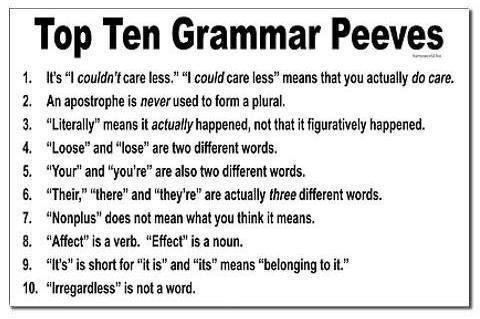
I’m probably going to reject it.  For example, literally.  While the dictionary does list a figurative meaning for the word now, it originally meant something actually happened.  So if your character says, “My head literally exploded”, you’d better get a mop, because you have a mess to clean up.  Ick.  And if their head literally exploded, how are we even discussing the matter with them?  Unless it’s from the POV of a dead character.  And while that’s been done quite well, it’s a very hard POV to pull off.  The word has been incorrectly used so much in daily language that even the dictionary has been infected.

And yes, I’m guilty of this.  I talk like that.  My head has literally exploded.  My heart has literally stopped.  I’ve literally been scared to death.  So how did I make this post?  I’m literally a ghost speaking to you from beyond the grave, that’s how.  *grin*  The word should actually be figuratively.

My head exploded, figuratively speaking.

But, since the dictionary now gives a figurative definition for literally, I suppose we’re stuck with it and will just have to suck it up and move on.  *sigh*  But there are other words authors misuse because they think the words mean something else.  It’s not uncommon, so I have no problem telling the author I don’t think they want to use that word there.  But when the author uses a lot of words incorrectly, that’s when I wonder if they’ve ever checked the definitions.  It’s easy to read a word in the context of one sentence and get the wrong impression, but you don’t want to consistently identify soup as gruel.  They’re similar, but not the same thing.

It’s easy to overlook a few of these instances, because the mind glosses over things and sees what it wants to, like the difference between reign and rein.  But, if you have a lot of these mistakes throughout the manuscript, you want to clear them up before submitting.  This is even worse if your query and synopsis contain a lot of these errors.


One additional remark about extra punctuation and all caps for emphasis.  Sometimes you do see it in books published by one of the Big Six, and that’s okay.  One, the “rules” of publishing change from time to time.  What was acceptable five years ago might not be acceptable now, and what’s acceptable now might not be acceptable in five years.  Two, it could also come down to the house style guidelines and requirements of the individual publisher.  If you really want to write, “YOOOOUUUUUU!!!!!!”, I’m likely to suggest changing it to “Yoooouuuuuu!” because several houses tell you not to use all caps for emphasis, and not to use multiple punctuation.  You’re better off not doing it.

Tuesday, February 10, 2015

Bad Grammar and Typos


Some self-published books are so full of grammar mistakes and typos that you can't get into an otherwise great story.

This is perhaps the easiest thing to fix for self-publishers.

Hire an editor!


Not your mom. Not your best friend. A real life editor.

It's going to cost money, but will be so worth it in the end.

Let's look at some examples of bad grammar. See if you can catch the mistakes.

Verb Tense Mistakes--
1. I go to church and sang in the choir.
2. I love to drink mild and ate chocolate cake.

Subject/Verb Mistakes--
3. Jesse and Heather is going to the movies on Friday.
4. I likes my puppy.

Noun/Pronoun Mistakes--
5. Maddie and Kennedy forgot her lunch money.
6. Everyone forgot their jacket.

Double Negatives--
7. He couldn't hardly believe she left him.
8. I never wanted none of your lies.

Some people have problems with fragments and run-on sentences. Although I agree they should be used carefully, I'm a big fan of fragments for driving home something with punch. Plus, inside my mind are lots of fragments and tremendously long run-on sentences. :) It's natural...sometimes.

Okay, were those examples really easy to catch?

Of course they were. Those were not your sentences or part of the story that's been taking up room in your head for the last few months. You were looking for mistakes. Some people can train themselves to self edit their own work. I am NOT one of those. When I reread my story I often skim through. I'll never catch all the little mistakes or typos.

Quick word on typos:
Most of my typos come from moving paragraphs or sentences around by cut and paste. Sometimes a word is left behind and it makes for a weird sentence. Other typos are from using the wrong spelling of a word--they're, there, their or to, too, etc.

When you hire an editor, they are coming in with fresh eyes and they know their job is to find the little mistakes.

Why are those little things so important? 

Because they throw your reader out of the story. You want each person reading your book to become immersed in the world and the problems of your characters. They don't want to remember they're reading words someone wrote. I know I don't. I want to escape reality for a couple of hours.

One or two little mistakes are not a big deal. But page after page of them will frustrate your reader and prevent them from forming the emotional connection needed to get lost in your book.

Questions for You:

Have you ever given up on a book because of bad grammar or typos?

Have you worked with an editor that you've loved? Please share their name and website in the comments!

I don't think I've ever quit reading a book simply because of grammar or typos, but those books rarely get more than 3 stars when I rate or review.

Two of my books were edited by Amie McCracken. I love, LOVE, love her! She has an amazing website that details the different types of edits available (if this post weren't so long I'd go over them). She is a professed lover of Indie authors and willing to work out pricing deals.

And one more because I couldn't resist. (Go to google and look up images for bad grammar for lots of laughs)
Other Links:
Grammar Girl
Grammarly.com
Thesaurus.com
Daily Writing Tips
GrammarBook.com
The Elements of Style
Grammarphobia
Common Errors in English Usage
English Grammar
Guide to Grammar and Writing