Title: Shadows in Secret
Genre: Historical Fiction
General area of the book the passage is from: First chapter
Why you feel this information is important: Because it explains who Molly is.
I really feel I need more backstory, but I'm too afraid of backstory, so this passage is short!
********
Molly had not lost her steadfast faithfulness to Alura, for which Alura was eternally grateful. She had always been more of a friend to Alura than a ladies maid. After the castle had been overrun and Sasha Leah’s troops had murdered the royal family, Alura was the only one to escape. The servants and field workers had been rounded up and herded off to the slave market. This is when Molly had proved her true friendship. At times, she proved more courageous than Alura. Older than Alura by five years, but still a friend she counted on for everything from advice on royal manners to private matters behind closed doors. At twenty years old, Alura still didn’t know much about being a wife.
Alura tried to remain unshakable, but at times she had crumbled under the burden of suffering. Some degree of protection had surrounded them as long as they marched close by the guard named Terious, but he had not always been there when the vicious soldiers beat upon them. Now, standing in line, Alura heard the whispers and rumors from the other captives. Those left at the end of the day were to be sold to the floating brothel resting in the harbor. How would she protect Mary and Natalie from the horrors awaiting them?

Showing posts with label back story. Show all posts
Showing posts with label back story. Show all posts
Saturday, October 20, 2012

Tuesday, October 16, 2012
Back Story Submission--Legacy of the Eye
Here's our first back story submission. My comments are in purple.
Title: The Legacy of the Eye
Genre: Science Fiction
General area of the book the passage is from: Chapter 2, page 18.
Why you feel this information is important: Illustrates David and Catrine's relationship before it falls apart.
"I've been giving graduation quite a bit of thought lately," David said. "It's disconcerting not to be able to plan ahead, as I don't know how my parents will react to my choices. I don't even know if they are still alive…"
"Your parents wouldn't have sent you to the Academy if they were interested in directing your future. And they know what your interests are, even if you haven't communicated them yourself. I'm sure you will be interested in visiting their home, wherever it may be. (this sentence slows things down for me. I think it's something you can show us later.) I think your problem is you have too many unknowns in your calculations for the first time in your life, and that's bothering you." I love the wording here. It really sets me in your world and gives Catrine this analytical vibe.
David smiled. Cat was always able to understand him and he knew she did not mean to reproach him (I didn't feel a reproach) for not writing to his parents these past years. Students at the Academy were encouraged to write to their relatives and communicate their interests and experiences. He knew Cat wrote often because she had mentioned it at various occasions. David, however, had not written to his parents in years. His last letter had been more like a note:
I made it into the Governance program. They said I was too young, but I told them age was not a requirement if I qualified. I did not have to argue too much. The instructors will probably tell you more.
David had discovered at the time that (this is really wordy. Try David knew the...)instructorsalways sent parents a student report reports about the students at the end of every quarter. Thus, he had decided there was no need for the duplicate effort. After they became friends, Cat had not argued with him when he explained his rationale for not writing to his parents.
Their friendship had started soon after Cat joined the Governance department, a couple of years after David had, when one of the instructors had paired them up for an assignment. David had been unhappy about the pairing at first. Not because she was a novice in the class--he had enjoyed working with the new students the year before--but because she was so quiet. However, he had found out soon enough that Cat would venture her opinions more freely when the two of them were working by themselves. Her critical thinking had amazed him. They had become friends at that point and had been inseparable ever since. Is there any way to condense this so that it's half the length? You can hint at his discomfort with her silence by sharing the moment he was first exposed to her "opinions".
David's concern, as they sat together in the Center Gardens, was that they might each have to follow a different path after graduation. They had great ideas to improve the Academy. The Tutor Program was only a first step and they had often talked about staying on Demia. The more he had learned about the other planets, the more he had thought the rest of the galaxy could benefit from all the things they learned at the Academy. But now David could not stop wondering from which planet they had come. He feared all the planning he and Cat had been doing together this past year was a waste of time. This paragraph is really confusing to me, but I'm going to assume some of it is mentioned before and therefore not as confusing as I think.
It feels like you have two lines of back story going here. 1) David getting into the program and not writing his parents, and 2)meeting Cat.
My questions for you would be--
I enjoyed all of the back story and feel it should be in here some where. It helps ground me in the world the author is creating as well as the relationship between the two characters.
Ask yourself--if I lived in this world it would all be normal, so how would it look to me? How would I react to it? Put yourself behind your MC's eyes and then LIVE. The way the character reacts to the world shows us the world as well as build that character.
Title: The Legacy of the Eye
Genre: Science Fiction
General area of the book the passage is from: Chapter 2, page 18.
Why you feel this information is important: Illustrates David and Catrine's relationship before it falls apart.
"I've been giving graduation quite a bit of thought lately," David said. "It's disconcerting not to be able to plan ahead, as I don't know how my parents will react to my choices. I don't even know if they are still alive…"
"Your parents wouldn't have sent you to the Academy if they were interested in directing your future. And they know what your interests are, even if you haven't communicated them yourself. I'm sure you will be interested in visiting their home, wherever it may be. (this sentence slows things down for me. I think it's something you can show us later.) I think your problem is you have too many unknowns in your calculations for the first time in your life, and that's bothering you." I love the wording here. It really sets me in your world and gives Catrine this analytical vibe.
David smiled. Cat was always able to understand him and he knew she did not mean to reproach him (I didn't feel a reproach) for not writing to his parents these past years. Students at the Academy were encouraged to write to their relatives and communicate their interests and experiences. He knew Cat wrote often because she had mentioned it at various occasions. David, however, had not written to his parents in years. His last letter had been more like a note:
I made it into the Governance program. They said I was too young, but I told them age was not a requirement if I qualified. I did not have to argue too much. The instructors will probably tell you more.
David had discovered at the time that (this is really wordy. Try David knew the...)instructors
Their friendship had started soon after Cat joined the Governance department, a couple of years after David had, when one of the instructors had paired them up for an assignment. David had been unhappy about the pairing at first. Not because she was a novice in the class--he had enjoyed working with the new students the year before--but because she was so quiet. However, he had found out soon enough that Cat would venture her opinions more freely when the two of them were working by themselves. Her critical thinking had amazed him. They had become friends at that point and had been inseparable ever since. Is there any way to condense this so that it's half the length? You can hint at his discomfort with her silence by sharing the moment he was first exposed to her "opinions".
David's concern, as they sat together in the Center Gardens, was that they might each have to follow a different path after graduation. They had great ideas to improve the Academy. The Tutor Program was only a first step and they had often talked about staying on Demia. The more he had learned about the other planets, the more he had thought the rest of the galaxy could benefit from all the things they learned at the Academy. But now David could not stop wondering from which planet they had come. He feared all the planning he and Cat had been doing together this past year was a waste of time. This paragraph is really confusing to me, but I'm going to assume some of it is mentioned before and therefore not as confusing as I think.
It feels like you have two lines of back story going here. 1) David getting into the program and not writing his parents, and 2)meeting Cat.
My questions for you would be--
- Is there a way to put the bit about getting in and letters somewhere else? Then just tighten it a bit.
- And, can you think of a way to SHOW us this relationship. Maybe they are sitting in the same place they've sat for the last X# of years? Have him think of how the smell of (fill in the blank with something in the room, or her soap, or something) will always remind him of how well they work together. Or show us how they've worked out some problem.
I enjoyed all of the back story and feel it should be in here some where. It helps ground me in the world the author is creating as well as the relationship between the two characters.
Ask yourself--if I lived in this world it would all be normal, so how would it look to me? How would I react to it? Put yourself behind your MC's eyes and then LIVE. The way the character reacts to the world shows us the world as well as build that character.
Remember, mine is just one opinion. What do YOU think of this submission?
Monday, October 15, 2012
Too Much Back Story In Your Novel?
Confession:
I love back story. I love to read and write it, but these days extensive back story is the kiss of death. Especially in the first chapters.
Today we're going to talk about back story, how it's important, and ways to use it to our advantage.
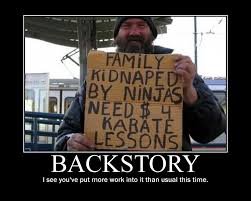
What is back story?
Everything that happened to your character before the book starts.
Why is it important?
Every author needs to know the character's back story in order to understand what motivates his/her desires and actions. Once we understand these things, we can write reactions that will feel natural and believable to the reader.
The hard pill to swallow is that the reader doesn't care what happened to your hero when he was five. Or that boys asked your female MC out on dares but never showed up for the actual date. None of that matters unless it has a direct impact on the plot and conflict in the current story.
Now, both things mentioned above are complete scenes in my head. I know how Landry felt as the events unfolded around him. What he looked like, how he wanted to cry but didn't, etc. I know how Talia dressed for the date that never happened and how she hid in the forest and cried so her mom wouldn't know. If I wanted, I could write out the scenes in vivid details, but it would completely stop my forward motion in the story and the reader would be thinking, "What the heck?"
How can we use information like that to our advantage?
Those details about my MC's lives give depth and affect how Landry and Talia react to things in the current story. If used correctly, back story can make your characters more human, likeable, believable, and many other things that readers are looking for. It can provide an emotional connection point.
I'm going to share how I used the above back story bits in my novel without going into an info dump.
Ladies first. At one point Talia is shocked to be asked out by a complete stranger. She's quite the recluse in the beginning of the book. Here's her reaction.
Notice it's short--about 110 words total.
In another spot, Landry asks Talia a very personal question. She replies simply.
Those two hints into Talia's past are at least 100 pages apart. No chance of it feeling like an info dump! However, they give a glimpse, and then a reminder as to why it's hard for Talia to trust people and let them into her life.
On to my hero. Landry seems a bit unfeeling at times to those around him, but as is true for most people, he simply keeps his emotions locked deep inside. There's a moment when Talia thinks him the most callous person she's ever met, but their telepathic connection reveals the truth.
This bit is only 80 words long. I included it because Talia needed to see a softer side of Landry. She needed to connect to who he is emotionally before she could let her walls down and learn to trust him.
Now, when I posted this on my blog last month someone asked a very important question.
What about flashbacks?
These are tricky too. If done right they can be the perfect way to get in a bit of back story. However, I think flashbacks are over used as an info dump tool. And more often than not, they are WAY too long.
Perhaps this is the real key to back story in any form--brevity. A line, a paragraph at most here and there is really enough. Even flashbacks can be slipped in so that the reader almost misses that they went back in time.
I don't use any flashbacks in The Magic Wakes, at least not that I can remember, but here is one from Fade Into Me:
(127 words)
When all is said and done, back story IS important, but too much is self indulgent on the author's part. It's not about us. It's only partially about our characters. It's all about the reader.
Title:
Genre:
General area of the book the passage is from:
Why you feel this information is important:
Submission Passage:
I'll post them Tuesday through Wednesday so we can all comment the rest of the week.
 Story bits are from my debut novel coming out February 2013.
You can learn more about Talia's story on my author website--charitybradford.com or on Goodreads.
I love back story. I love to read and write it, but these days extensive back story is the kiss of death. Especially in the first chapters.
Today we're going to talk about back story, how it's important, and ways to use it to our advantage.
What is back story?
Everything that happened to your character before the book starts.
Why is it important?
Every author needs to know the character's back story in order to understand what motivates his/her desires and actions. Once we understand these things, we can write reactions that will feel natural and believable to the reader.
The hard pill to swallow is that the reader doesn't care what happened to your hero when he was five. Or that boys asked your female MC out on dares but never showed up for the actual date. None of that matters unless it has a direct impact on the plot and conflict in the current story.
Now, both things mentioned above are complete scenes in my head. I know how Landry felt as the events unfolded around him. What he looked like, how he wanted to cry but didn't, etc. I know how Talia dressed for the date that never happened and how she hid in the forest and cried so her mom wouldn't know. If I wanted, I could write out the scenes in vivid details, but it would completely stop my forward motion in the story and the reader would be thinking, "What the heck?"
How can we use information like that to our advantage?
Those details about my MC's lives give depth and affect how Landry and Talia react to things in the current story. If used correctly, back story can make your characters more human, likeable, believable, and many other things that readers are looking for. It can provide an emotional connection point.
I'm going to share how I used the above back story bits in my novel without going into an info dump.
Ladies first. At one point Talia is shocked to be asked out by a complete stranger. She's quite the recluse in the beginning of the book. Here's her reaction.
"I would love to take you to dinner, Miss Zaryn. Show you around Joharadin."What does this passage tell you about Talia?
Talia's mouth dropped open for the second time that day. She looked him over, wondering if she could bear to give dating another shot. He looked to be about her height, brown eyed and plain in every way except his build. His muscles barely fit in his uniform, giving him a stiff pained look around the shoulders. Her mind drifted to her school days. Ardro Gunik, tall, built, and popular. He asked her out once too. On a dare. The memory still prickled.
"I'm sorry, I can't." She grabbed the pass, and bolted for the security gate.
Notice it's short--about 110 words total.
In another spot, Landry asks Talia a very personal question. She replies simply.
"Guys usually…" The muscle in her jaw clenched. "Well, they kept their distance. I guess I'm not the dating type."
Those two hints into Talia's past are at least 100 pages apart. No chance of it feeling like an info dump! However, they give a glimpse, and then a reminder as to why it's hard for Talia to trust people and let them into her life.
On to my hero. Landry seems a bit unfeeling at times to those around him, but as is true for most people, he simply keeps his emotions locked deep inside. There's a moment when Talia thinks him the most callous person she's ever met, but their telepathic connection reveals the truth.
When did you stop caring about other people's deaths?
The image of a small boy standing on the steps of the palace came to her mind. He watched soldiers carry a man up the stairs on a stretcher. They stopped in front of him and the man reached out a hand as blood bubbled from his mouth. Talia descended to a familiar pain, the sense of complete loss. The scene disappeared as Landry shielded his mind from her once more.
This bit is only 80 words long. I included it because Talia needed to see a softer side of Landry. She needed to connect to who he is emotionally before she could let her walls down and learn to trust him.
Now, when I posted this on my blog last month someone asked a very important question.
What about flashbacks?
These are tricky too. If done right they can be the perfect way to get in a bit of back story. However, I think flashbacks are over used as an info dump tool. And more often than not, they are WAY too long.
Perhaps this is the real key to back story in any form--brevity. A line, a paragraph at most here and there is really enough. Even flashbacks can be slipped in so that the reader almost misses that they went back in time.
I don't use any flashbacks in The Magic Wakes, at least not that I can remember, but here is one from Fade Into Me:
(127 words)
"It's so beautiful." I let go of the cord and stepped carefully to the side for a better view.I think it works because Ry doesn't even realize it IS a flashback. The reader knows, but she doesn't.
Carter took over the heat and we lifted higher. "I knew you would enjoy this."
I gasped and gripped the rim tighter. One moment he stood in the basket wearing his jeans and t-shirt, then everything spun until he stood at the top of a staircase. His hand was held out to me, his clothes suggestive of a renaissance fair complete with a silver circlet around his head. He was the only solid thing in a swirl of moving color.
"What is it Ryanne?" He let go of the cord and pulled me back to the middle of the basket and reality once more. "Are you all right?"
When all is said and done, back story IS important, but too much is self indulgent on the author's part. It's not about us. It's only partially about our characters. It's all about the reader.
Call for submissions!
Send in your passages of back story up to 500 words to unicornbellsubmissions @ gmail.com and we'll try to help you decide how to make it the most effect without slowing your story momentum. Please add the following to your email--Title:
Genre:
General area of the book the passage is from:
Why you feel this information is important:
Submission Passage:
I'll post them Tuesday through Wednesday so we can all comment the rest of the week.

You can learn more about Talia's story on my author website--charitybradford.com or on Goodreads.
Thursday, August 9, 2012
Finding Out Why
I don’t outline. That is, I can’t sit down and bullet point all the aspects of my story. Instead, what I do I call a short draft.
A short draft is kind of like a summary I write before I write the story. It hits all the main plot points and it’s all tell/no show. It’s a way to organize my story in my head. Things may not go the way I plan, but it still helps to have some sort of map.
I wrote a short draft for the story in the point of view of my main character. Now it’s time to do the same for this evil wizard.
I have a what. I need a why. Why would this wizard go to all this trouble to work such a spell? It has to be for love.
Then all the pieces fell into place. Take a lost love. Combine it with the characters and situations I already had. Mix until it makes sense. Let the ingredients bake together. And a climax that makes sense emerges.
Whew! For a while there, I thought I was going to have to give up.
How do you “map out” your story (if you’re a plotter)? Do you outline? Or do you do something similar to what I do?
Tuesday, August 7, 2012
The Mysterious Bad Guy
I’m not one to give up on a story. Sure, I have a bunch of unfinished stories that call to me from time to time, but I’ll get back to them. I swear. Eventually. But I don’t think my current work in progress (book one of a planned trilogy) needs to be abandoned just yet. I may be able to save it.
I understand my point of view character. The main characters are all well known to me. I even have a handle on the big bad guy (he’s evil in an if-you-cross-me-I’ll-have-you-killed sort of way).
However, the big bad guy doesn’t have a huge role in book one. He’s there, but he’s influencing things from afar. The main antagonist for book one is a wizard, and he’s a mystery to me.
I think my main problem is that this wizard doesn’t have a lot of scenes “on screen”. But his machinations in the background set the whole plot in motion. I have to know who he is and what he’s about.
You’d think I would have already figured this out. Sigh.
Are your bad guys “on screen” a lot? Or do they influence things from the background?
Monday, August 6, 2012
Story Problems
I’m having problems with the ending of my current story. And it’s making me a little crazy.
I got stuck on my last novel, too. It got to the point where I had to set the thing aside and let it rest for a while. Luckily, it’s my new normal to have several stories going at once, so I had something to jump to.
However, this time what I jumped to wasn’t as fully thought out as my stories usually are. I know that this will be a trilogy. I know where each part begins and ends. But now that I’m actually writing the first one, I find that there are certain weaknesses.
The ending.
I know where the end needs to go. I know what my characters need to be at that point. I know where the next story begins. The one thing I’m missing is a climax.
Back to the drawing board.
Have you ever abandoned a project because it wasn’t coming together? Should I just trash this and move on?
Tuesday, May 22, 2012
Dangerous Territory
I'm about to step into it.
This week we are talking about endings and how to do them well. Hopefully you've found some that you want to share with us this week. I think the best way to do it is for you to email me the title of the book and why the ending worked for you. Don't worry about spoilers too much, be honest and detailed with what worked for you. (unicornbellsubmissions@gmail.com with Endings in the subject line)
Today I want to talk about what NOT to do. Please don't stone me when I'm done.
 Tolkien managed to get away with something we will never be allowed to do. Ever.
He wrote 100 more pages of story after the climax of The Return of the King.
Stay with me a minute. The ring is destroyed on page 250 of my paperback copy. Sam and Frodo are reunited with all their friends on page 255. Said friends have just finished a mighty battle a page before that sees the orcs running away.
At this point, all the tension has been released. There is nothing else for us to worry about. Not really. However Tolkien spends another 92 pages getting our heroes back home, cleaning up said home from the riff raff that's taken over, and then getting the elves, Bilbo, and Frodo on the boats to the west.
Now, I LOVE Tolkien and The Lord of the Rings, but as a writer today, I don't have the luxury of spending 90 some odd pages to tie up all the threads and bring the story to a complete end. I wish I could. It's in my head, but the reader gets bored once the conflict is over. I admit I got a little bored after the war was over myself.
The moral here is:
This week we are talking about endings and how to do them well. Hopefully you've found some that you want to share with us this week. I think the best way to do it is for you to email me the title of the book and why the ending worked for you. Don't worry about spoilers too much, be honest and detailed with what worked for you. (unicornbellsubmissions@gmail.com with Endings in the subject line)
Today I want to talk about what NOT to do. Please don't stone me when I'm done.
He wrote 100 more pages of story after the climax of The Return of the King.
Stay with me a minute. The ring is destroyed on page 250 of my paperback copy. Sam and Frodo are reunited with all their friends on page 255. Said friends have just finished a mighty battle a page before that sees the orcs running away.
At this point, all the tension has been released. There is nothing else for us to worry about. Not really. However Tolkien spends another 92 pages getting our heroes back home, cleaning up said home from the riff raff that's taken over, and then getting the elves, Bilbo, and Frodo on the boats to the west.
Now, I LOVE Tolkien and The Lord of the Rings, but as a writer today, I don't have the luxury of spending 90 some odd pages to tie up all the threads and bring the story to a complete end. I wish I could. It's in my head, but the reader gets bored once the conflict is over. I admit I got a little bored after the war was over myself.
The moral here is:
If you are J.R.R. Tolkien, you can do whatever you want.
But you are NOT Tolkien.
And neither am I.
Normal folks like us would need to end the story by page 260.
Thoughts? Am I completely off my rocker?
Monday, October 17, 2011
Stuck in the Middle
Greetings Friends!
So glad to be here! Thanks for joining me in my first post at Unicorn Bell. As a fellow writer, but more importantly as a reader and book purchaser, I love a good book! Don’t you? So let’s see how we can make ours better!
The best place to start is at the beginning. We excite the reader with a great hook, maybe an incident or intriguing characters, a problem arises, tension, relationship possibilities… go go go!

Then we have to stop and wait for the elevator. We have reached the tough middle. Hold on while I tell you some background and explain things and here’s an info dump, zzz to the easy listening muzak. We have lost momentum. (think Blues Brothers)
When I’m reading, if the beginning was awesome I might plow through the dull parts to see how it ends. But if I can predict it, I don’t bother since it seems I’ve already read the good parts. Could an agent think this too? Oh no! We don’t want that!
So how do we keep the reader turning pages, anxious to see what’s next?
Here is some more advice for keeping a reader hooked from Charity. And this just in, Abby wrote a post about putting problems into our story, on purpose!
Write on!
Tara
So glad to be here! Thanks for joining me in my first post at Unicorn Bell. As a fellow writer, but more importantly as a reader and book purchaser, I love a good book! Don’t you? So let’s see how we can make ours better!
The best place to start is at the beginning. We excite the reader with a great hook, maybe an incident or intriguing characters, a problem arises, tension, relationship possibilities… go go go!

Then we have to stop and wait for the elevator. We have reached the tough middle. Hold on while I tell you some background and explain things and here’s an info dump, zzz to the easy listening muzak. We have lost momentum. (think Blues Brothers)
When I’m reading, if the beginning was awesome I might plow through the dull parts to see how it ends. But if I can predict it, I don’t bother since it seems I’ve already read the good parts. Could an agent think this too? Oh no! We don’t want that!
So how do we keep the reader turning pages, anxious to see what’s next?
- Is it imperative to the story? I love my back story. I know why my characters act the way they do, where they are from, their past training and experiences, but does the reader need this info? Most likely not. If the info has nothing to do with what is happening, cut it.
- Yes, it is. Fine. Keep it. And here is some advice I'm passing on as to how:
- Spread it around – dole it out in smaller portions, no big long narrations
- Avoid Bob – heard of “as you know, Bob?” this is where a character explains something to another character that they both already know, but the writer wants to tell the reader…don’t do it. This is telling - show it!
- Make it smooth – we may want to tell the reader back story right away, but wait for the opportune moment. Don’t force it. The trick is to sprinkle it into the action so the reader has no idea they are being educated.
- Keep the engine revved. Most importantly, have enough action between slow spots by adding incidents or surprises. We want to keep the reader on her toes! Vroom, vroom!
Here is some more advice for keeping a reader hooked from Charity. And this just in, Abby wrote a post about putting problems into our story, on purpose!
Write on!
Tara
Subscribe to:
Posts (Atom)